
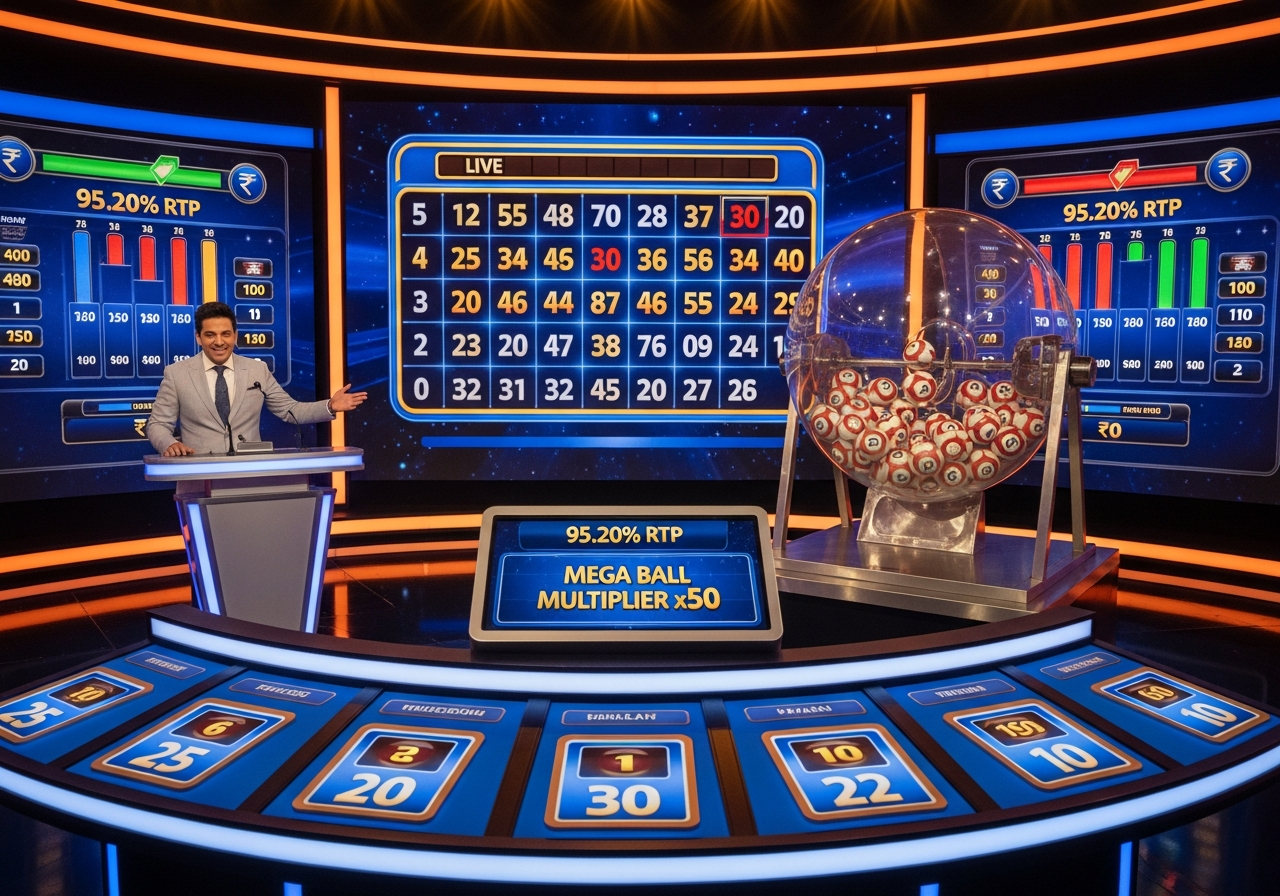
Evolution’s Mega Ball Live stands as one of the most exciting lottery-style game shows available to international online casinos, including those serving Indian players. For those considering play with rupees through international platforms, understanding the odds, Return to Player (RTP), and payout mechanics is essential for making informed decisions and managing your bankroll responsibly. This guide focuses specifically on Mega Ball’s odds and payouts from an Indian player’s perspective, translating key numbers into practical rupee-based examples.
Mega Ball is classified as a high-volatility, entertainment-first game. Unlike skill-based card games or table games with lower variance, Mega Ball delivers extended dry spells followed by occasional significant wins. Learning how odds and RTP work helps Indian players set realistic expectations, avoid chasing losses, and enjoy the game within a controlled budget. Rather than promising a path to profit, this guide equips you with the mathematical foundation to play with discipline and awareness.
Overview of Mega Ball Live Odds for Indian Players
Mega Ball Live is Evolution’s proprietary lottery-style game show that combines elements of bingo with multiplier bonuses. Players purchase numbered cards—typically 5×5 grids with 24 active numbers—and win by completing lines (usually five in a row) as balls are drawn. The game’s signature feature is the Mega Ball bonus, a random multiplier applied to winning lines, which can theoretically boost payouts up to 1,000,000×, though practical casino caps typically limit maximum wins to around €500,000 (roughly ₹40–42 lakhs at current rates).
Key odds figures for Indian players include an RTP range of approximately 95.05–95.40%, translating to a house edge of 4–5%. This means that on every ₹100 wagered over an infinite sample, players can expect to lose ₹4–5 to the house in the long run. Mega Ball’s RTP sits above typical lottery-style games but trails popular table games like roulette or blackjack. When betting is available in rupees or rupee-equivalent stakes, minimum bets often start at ₹10–₹50 per card, with no fixed maximum on international platforms—though effective caps exist due to the €500,000 win limit.
How Mega Ball Works in Simple Terms
Understanding Mega Ball’s mechanics is the first step to grasping its odds:
- Purchase cards – Players select how many numbered cards to play in a single round, typically ranging from 1 to 400+. Each card costs a fixed amount (e.g., ₹50 per card).
- Card layout – Each card is a 5×5 grid with a free (wild) centre square and 24 numbered spaces, divided into 12 winning lines (horizontal, vertical, or diagonal combinations).
- Ball draws – The live host draws approximately 20–21 balls over the course of the round. Players mark their cards as numbers appear.
- Line wins – Completing one or more full lines qualifies that card for a payout. A single line might trigger a modest win; multiple lines on the same card or multiple cards create escalating payouts.
- Mega Ball activation – After the main draws conclude, a special Mega Ball is drawn. This ball is assigned a random multiplier (often ranging from 1× to 100× or higher), which is applied to all pending line wins in that round.
- Payout calculation – The base payout for each line is multiplied by the Mega Ball multiplier, and winnings are credited to the player’s account.
The odds of completing specific numbers of lines depend on how many cards are played, the numbers drawn, and variance. A single card typically has odds of around 1 in 6 to 1 in 10 of completing at least one line per round, though this shifts with more cards in play.
Why Odds Are Different From Traditional Lottery or Slots
Mega Ball’s odds profile differs meaningfully from other popular games. Traditional lotteries like those in many countries often feature RTPs as low as 50–70%, with astronomical odds against the jackpot. Online slots typically offer RTPs of 92–98%, depending on the game and casino. Mega Ball’s RTP of 95.05–95.40% places it in the middle-upper range—better than most lottery products but slightly behind premium slots and table games.
The critical distinction is volatility. Standard online slots, even volatile ones, usually reset between spins independently. Mega Ball’s results are correlated across all cards in a round, and the multiplier is a single event shared by all players. This creates a unique variance profile: most rounds produce no wins for most players, but when the Mega Ball multiplier lands on 50× or higher, winners can be substantial. For Indian players, this means budgeting for extended losing streaks (perhaps 10–15 dry rounds in a session) punctuated by occasional wins that may or may not offset losses. Treating Mega Ball as entertainment rather than an income opportunity is essential.
Mega Ball RTP and House Edge Explained for Indian Players
| Scenario | RTP % | House Edge % | Notes for Indian Players |
|---|---|---|---|
| Standard single/few cards per round | 95.05–95.40 | 4.60–4.95 | Expected loss of ₹4.60–₹4.95 per ₹100 wagered over long play |
| High-volume play (100+ cards) | ~95.30 | ~4.70 | Variance increases; short-term results deviate more from RTP |
| Promotional/bonus rounds (if available) | Variable | Variable | Check operator terms; bonuses may carry higher house edges or wagering locks |
| Multi-round session average | 95.05–95.40 | 4.60–4.95 | Realistic expectation for a typical 10–20 round session |
The RTP (Return to Player) percentage represents the theoretical average payout to players over an extremely large sample of rounds. A 95.20% RTP means that mathematically, players will recover ₹95.20 of every ₹100 bet in the long term, with the casino keeping ₹4.80. Conversely, the house edge—4.80% in this case—quantifies the casino’s mathematical advantage per unit wagered.
For practical planning, these figures translate into expected loss per session. If you play ₹10,000 across a series of Mega Ball rounds at 95.20% RTP, your long-run expected loss is ₹480. However, due to variance, actual single-session results will often deviate significantly. You might lose ₹2,000 or win ₹1,500 depending on luck—RTP is a measure of central tendency over thousands of rounds, not a guarantee for any individual session.
RTP Range vs Number of Cards Per Round
The published RTP for Mega Ball can vary slightly depending on how many cards are played in a typical round. Increasing the number of cards reduces the variance per card but increases the total amount wagered per round. Some casinos may publish slightly different RTPs (e.g., 95.05% vs 95.40%) based on assumed player behaviour, such as average cards per round. The fundamental principle remains: the house edge is built into the game’s probability model and cannot be overcome by bet sizing or card selection. Playing 10 cards does not improve your percentage return compared to playing 1 card; it simply spreads your total wager across more potential lines, increasing both coverage and overall volatility per round.
Mega Ball Payout Structure and Lines per Card
| Number of Winning Lines | Base Multiplier (No Mega Ball) | Possible Range with Mega Ball Multiplier | Indicative Payout in ₹ (Example: ₹50 per Card) |
|---|---|---|---|
| 1 line | 1× | 1×–100× | ₹50–₹5,000 |
| 2 lines | 2× | 2×–200× | ₹100–₹10,000 |
| 3 lines | 5× | 5×–500× | ₹250–₹25,000 |
| 4 lines | 10× | 10×–1,000× | ₹500–₹50,000 |
| 5 lines | 20× | 20×–2,000× | ₹1,000–₹100,000 |
| 6+ lines | 50×–100× | 50×–5,000,000× | ₹2,500–₹250,000,000 (capped at €500K / ₹42L) |
This table illustrates how payouts escalate with winning line counts. The “base multiplier” column represents typical payouts if the Mega Ball draw produces a standard 1× outcome (no bonus). The “Mega Ball multiplier” range shows potential wins when bonus multipliers of 5×, 10×, 50×, or higher are applied. For example, if you play five cards at ₹50 each and hit 3 winning lines on one card, the base payout might be ₹250 (3 lines × 1× × ₹50). If the Mega Ball then draws a 20× multiplier, that win becomes ₹5,000. Conversely, if you complete 6 lines across multiple cards and the Mega Ball lands on 100×, the theoretical payout could be enormous—though the casino’s maximum win cap (around €500,000 or ₹42 lakhs) would apply if you exceed it.
It is important to note that these payouts assume you have purchased the cards and completed the lines. Not all cards win in every round; in fact, most rounds result in no wins for most players. The payout table shows the potential if you win, but the base probability of winning at least one line per card per round is typically 15–25%, depending on the number of balls drawn and cards played.
Card Layout, Lines and Coverage
Each Mega Ball card is a standard 5×5 bingo grid with one free (wild) centre square. This layout yields 12 possible winning lines: five horizontal lines, five vertical lines, and two diagonals. To complete a line, you need all five squares in a row marked (four numbers plus the free centre). With 24 active number spaces and approximately 20–21 balls drawn per round, the odds of completing at least one line on a single card are moderate but not high—roughly 20–25% per round.
When you purchase multiple cards in a single round, each card is independent. Buying 10 cards does not give you 10 times the probability of winning overall; rather, it spreads your wager across 10 separate chances. If each card has a 22% chance of completing at least one line, playing 10 cards improves your odds of the round producing any win to around 92%, but the total wager also increases proportionally. This is why card selection and bankroll management are critical for Indian players.
Max Win Limits vs Theoretical Multipliers
Mega Ball’s theoretical maximum multiplier is 1,000,000×. In an extremely rare scenario where you play many cards, hit 6+ lines on multiple cards, and the Mega Ball lands on its highest possible multiplier, payouts could theoretically reach millions of rupees. However, virtually all online casinos impose a maximum win cap, typically around €500,000 (approximately ₹40–42 lakhs depending on exchange rates). This cap ensures that even the most extreme lucky round is bounded, protecting both player risk management and the operator’s financial exposure.
For practical purposes, Indian players should assume a maximum payout of around ₹35–40 lakhs per round. Reaching even €100,000 (₹8–9 lakhs) is exceptionally rare and requires a combination of multiple winning cards, high line counts, and a strong Mega Ball multiplier. Designing bankroll and session strategies around a realistic maximum of ₹5–10 lakhs per session is far more prudent than chasing the theoretical 1,000,000× dream.
Mega Ball Multipliers and Their Probabilities
| Multiplier | Approximate Frequency | Impact on Payouts | Risk/Reward for Indian Players |
|---|---|---|---|
| 1× | ~35–40% | No bonus; base payout only | Common; often results in small returns or no return if no lines complete |
| 2×–5× | ~25–30% | Modest 2–5× boost | Regular occurrence; helps offset cost of multiple cards |
| 5×–20× | ~15–20% | Significant multiplier; starts to create meaningful wins | Uncommon but achievable; can produce ₹5,000–₹20,000 wins from modest card investments |
| 20×–100× | ~5–10% | High multiplier; substantial wins | Rare; creates session-winning outcomes for disciplined players |
| 100×+ | <5% | Extreme multipliers; life-changing payouts | Very rare; should never be relied upon as part of a strategy |
The multiplier distribution is proprietary information that Evolution does not fully disclose, but empirical observation from gameplay footage and community reports suggests that low multipliers (1×–5×) occur in roughly 60–70% of rounds, while multipliers above 20× appear in fewer than 10% of rounds. Understanding this distribution is crucial: most rounds will deliver modest returns, and high-multiplier events are outliers that should never form the basis of your bankroll expectations.
For Indian players, the practical implication is that a session of 10 rounds with an average of 15 cards per round might look like: seven rounds with 1×–5× multipliers (most producing no wins or small wins), two rounds with 10×–15× multipliers (producing wins in the ₹2,000–₹8,000 range if lines are hit), and one round with a 30×+ multiplier (possibly a significant win). Variance is high, and this distribution can shift wildly in either direction over small sample sizes.
How Mega Ball Bonus Rounds Affect Expected Value
The Mega Ball multiplier is fundamentally a variance tool rather than an expected value tool. That is, multipliers redistribute wins between players and rounds but do not reduce the house edge. If your RTP is 95.20% at 1× multipliers, it remains 95.20% when multipliers are factored in—the multipliers simply add volatility. Some players win more, some win less, and the house still keeps its 4.80% long-term edge.
Incomplete or uncleared lines do not count toward payouts even if the multiplier is exceptionally high. You cannot, for example, complete 4 out of 5 squares in a line and cash out; only complete lines are eligible. This reinforces that Mega Ball is a binary outcome game: you either complete a line or you do not. The multiplier amplifies complete wins, not near-misses.
Cards Per Round, Variance and Bankroll Impact
- 10 cards per round – Suitable for players with a ₹500–₹1,000 entertainment budget for a session. Costs ₹500–₹1,000 per round at ₹50 per card. Variance is moderate; you will experience many dry rounds but occasional wins can offset the cost. Expected long-term loss per session: ₹20–₹50.
- 25–30 cards per round – Appropriate for a ₹2,000–₹3,000 session budget. Costs ₹1,250–₹1,500 per round. Significantly increases coverage and the chance of completing at least one line per round. Variance is high; you might see no wins in five rounds or multiple wins in one round. Expected loss: ₹50–₹120 per session.
- 50 cards per round – Suitable for dedicated players with a ₹5,000+ session budget. Costs ₹2,500 per round. Very high coverage and likelihood of completing lines regularly, but also means you are wagering a substantial amount. Variance is lower per-line probability but higher in absolute terms. Expected loss: ₹120–₹240 per session.
- 100+ cards per round – High-volume play targeting players with ₹10,000+ session budgets or those clearing bonuses. Costs ₹5,000+ per round. Combines high coverage with high absolute volatility and rapid play. Expected loss: ₹240–₹500 per session.
Playing more cards increases your probability of landing lines but also increases your total wagering and variance. A player with a ₹2,000 budget who plays 40 cards at ₹50 each for five rounds expects to spend ₹10,000 total (exceeding budget) and face ₹470 expected loss. Conversely, a player with a ₹2,000 budget playing 10 cards at ₹20 each for 10 rounds spends ₹2,000 exactly, with an expected loss of around ₹94.
Low, Mid and High Budget Setups for Indian Players
- Low-budget setup (₹500–₹1,000 session) – Play 10 cards at ₹50 each, one round. Expected time: 10 minutes. Wager: ₹500. Expected loss: ₹23. Purpose: casual entertainment, learning game mechanics. Risk: limited upside but also limited loss.
- Mid-budget setup (₹2,000–₹3,000 session) – Play 8 cards at ₹50 each, four rounds. Expected time: 45 minutes. Wager: ₹1,600. Expected loss: ₹76. Purpose: balanced recreation with moderate coverage and extended play. Risk: moderate variance; possible wins of ₹500–₹5,000 or total loss.
- High-budget setup (₹5,000–₹10,000 session) – Play 20 cards at ₹50 each, five rounds. Expected time: 60 minutes. Wager: ₹5,000. Expected loss: ₹240. Purpose: dedicated player seeking regular line hits and multiplier excitement. Risk: high; variance can produce ₹10,000+ wins or near-total loss.
Understanding Volatility and Downswings
Mega Ball’s high volatility means that short-term outcomes deviate substantially from expected value. It is entirely realistic to play 15–20 rounds, hit only two or three lines, and lose money even if you “should” break even based on RTP. Conversely, a lucky streak of 3–4 high-multiplier hits can produce a 20–30% gain in a single session.
A typical downswing might look like: five consecutive rounds with no line completions (₹500 wagered, ₹0 returned). This is not unusual and should be expected roughly every 5–10 sessions for players buying 10 cards per round. Bankroll planning must account for streaks of 5–10 dry rounds before a significant win. Setting a session loss limit (e.g., never lose more than ₹1,000 in one session) and taking breaks is essential to avoid chasing losses.
Real Odds vs Popular Mega Ball Strategies
- Strategy: “Play more cards to increase coverage” – Mathematically sound for increasing line completion probability per round, but does not improve RTP. Net effect: more constant play, higher variance, faster bankroll consumption. Use wisely with adequate budget.
- Strategy: “Change cards after a losing round” – Superstitious; cards are randomly assigned each round. Changing cards does not affect odds. Not recommended unless it helps you feel less frustrated (a psychological benefit, not a mathematical one).
- Strategy: “Watch for cold/hot multipliers and adjust stakes” – Multipliers are drawn randomly and are not “due” or “overdue.” Betting more after a cold streak is a path to larger losses. The Mega Ball outcome is independent each round.
- Strategy: “Optimize card count based on session budget” – Evidence-based and recommended. Matching cards per round to your total session budget ensures you can play multiple rounds and manage variance. Refer to the budgeting section above.
- Strategy: “Set a win target and stop when reached” – Practical harm-reduction approach. If you enter with ₹2,000 and hit ₹500 in wins after three rounds, stopping and banking ₹500 profit is a win. This prevents extended play that erodes gains due to house edge.
- Strategy: “Claim bonuses for Mega Ball playthrough” – Mathematically neutral if the bonus carry the same house edge. If bonuses have better effective RTP due to lower rollover, they can be worthwhile. Always read the fine print.
What Indian Players Should and Shouldn’t Expect From Strategy
No strategy can overcome the 4.60–4.95% house edge built into Mega Ball’s RTP. Card selection, bet sizing, and timing decisions do not change the long-term return. What strategy can do is manage variance, extend session length, reduce emotional decision-making, and help protect your bankroll. Approaching Mega Ball with disciplined rules—fixed session budgets, card-count planning, exit triggers—is the realistic path to sustainable play. Expecting consistent profits or “beating the odds” is not.
Playing Mega Ball Legally and Safely from India
- Choose licensed operators – Verify that the casino holds a valid gaming license from a recognized jurisdiction (Malta, Curacao, UK Gambling Commission, or equivalent). Avoid unregulated sites.
- Confirm KYC procedures – Reputable casinos require identity and address verification before deposits and withdrawals. This protects you against fraud and money laundering links. Complete KYC honestly and keep documentation.
- Use secure payment methods – Deposit and withdraw using trusted channels: credit cards, e-wallets (Skrill, Neteller), bank transfers, or crypto (where available). Avoid unencrypted transfers or third-party intermediaries.
- Check withdrawal policies – Confirm that the casino permits withdrawals in rupees or to your preferred payment method. Some casinos cap withdrawals or impose extended processing times; clarify these beforehand.
- Enable account controls – Most regulated casinos offer deposit limits, session limits, and self-exclusion tools. Use these to enforce your bankroll rules.
- Keep records – Document your wagers, wins, and losses for personal tracking and potential tax purposes (tax treatment of casino winnings varies by jurisdiction).
- Avoid chasing licenses through VPNs or workarounds – While many international casinos accept Indian players, some do not. Do not misrepresent your location or use VPNs to access restricted platforms; this can void winnings.
KYC, Payment Methods and Currency Considerations
Know Your Customer (KYC) requirements are standard at licensed casinos. You will typically need to provide: a valid passport or national ID, proof of address (utility bill or bank statement), and sometimes a selfie or video verification. This process, though occasionally inconvenient, protects both you and the operator. Processing usually takes 24–48 hours.
Payment methods for Indian players vary by operator. Direct INR deposits are increasingly common through bank transfers or UPI partnerships. Other options include e-wallets like Skrill (which support INR), Bitcoin, or traditional credit card deposits followed by internal currency conversion. Withdrawal minimums often range from ₹1,000–₹2,000, and processing can take 3–7 business days depending on the method. Some casinos cap daily or monthly withdrawals; note these limits before large wins.
Currency conversion fees should be factored into your budget. If a casino operates in EUR and you deposit INR, you may face a 1–3% conversion spread. Similarly, winnings in EUR converted back to INR attract market rates plus any operator markup. Tracking these conversions helps you understand your true cost and returns.
Responsible Gambling for a High-Variance Game Show
Because Mega Ball is high-volatility entertainment, responsible gambling frameworks are particularly important:
Set an entertainment budget. Allocate 10–20% of your discretionary monthly income as your total gaming budget. For example, if you have ₹5,000/month in discretionary spending, allocate ₹500–₹1,000 for all casino play. This is money you are prepared to lose.
Define session limits. Before each Mega Ball session, decide your maximum loss (e.g., ₹500) and maximum win target (e.g., ₹250). When either is reached, stop playing. Do not chase losses by re-depositing or borrowing.
Track time, not just money. Set a session time limit (e.g., 45 minutes) and stick to it. High-volatility games can induce “zone-out” play where you lose track of time and stakes.
Avoid high-risk multiplier chasing. Do not increase stakes hoping for a 50× or 100× Mega Ball; the odds are against you, and the emotional spike after a miss can lead to poor decisions.
Recognize warning signs. If you find yourself depositing more than planned, hiding losses from family, or playing with borrowed money, seek help. The National Council of Addiction Treatment (India) and international resources like Gamblers Anonymous offer support.
Advanced Odds Insight and Mega Ball vs Other Casino Games
| Game Type | Typical RTP | Volatility | Suitability for Indian Bankrolls |
|---|---|---|---|
| Mega Ball | 95.05–95.40% | Very High | Medium; entertainment focus, unpredictable short-term results |
| European Roulette | 97.30% | Medium | High; stable, predictable variance, longer session sustainability |
| Teen Patti (skill-based) | 85–95% (variable) | Medium-High | Medium; depends heavily on skill and table stakes |
| Andar Bahar | 97.50% | Low | High; fast, simple, predictable house edge |
| Standard Video Slots | 92–98% | High | Low-Medium; high variance without social element of live shows |
| Live Blackjack | 99–99.50% | Low | Very High; best mathematical odds available, lowest volatility |
Mega Ball occupies a unique niche: its RTP (95.05–95.40%) is decent but trails blackjack and some roulette variants. Its volatility is higher than most table games, meaning variance-sensitive players might prefer Teen Patti or roulette for sessions with more predictable ranges. However, for players attracted to the live game show experience and willing to accept higher variance, Mega Ball offers more engagement than standard slots. In a diversified casino diet, Mega Ball fits as a periodic entertainment choice rather than a primary game, especially for Indian players with limited bankrolls where variance can quickly deplete funds.
Using Odds Knowledge to Plan Your Mega Ball Sessions
- Decide your session budget. Example: ₹2,000. Based on this, determine how many rounds and cards make sense. Five rounds of 8 cards at ₹50 each = ₹2,000 total.
- Set a loss limit and a win target. Loss limit: ₹1,500 (75% of budget—accommodates variance while protecting capital). Win target: ₹300 (15% gain). If either is reached, end the session.
- Choose a card strategy that matches your comfort. If you prefer frequent small wins, play 20+ cards per round (expect wins more often but in smaller amounts). If you prefer fewer, larger wins, play 5–10 cards (longer dry spells but bigger payouts when multipliers align).
- Play your planned number of rounds regardless of interim results. Avoid the trap of “one more round” after losses or early exits after wins. Stick to your session plan to let variance average out and reduce emotional decision-making.
- Track outcomes and reflect. After each session, note the number of rounds, cards, total wagered, total returned, and net result. Over 10+ sessions, your actual return should approach the theoretical RTP. If it deviates significantly (much worse), consider whether you are playing in controlled conditions or if variance is taking a toll on your bankroll.
- Adjust future sessions based on results and mood. If you are on a losing streak or feeling frustrated, reduce session budgets or skip a round. If you are enjoying the experience and within your long-term budget, continue at a comfortable level.
—
Understanding Mega Ball’s odds, RTP, and payout mechanics empowers Indian players to enjoy the game responsibly and with realistic expectations. The 95.05–95.40% RTP means a persistent house edge, high variance means short-term outcomes will vary wildly from the theoretical average, and strategic play focuses on bankroll management rather than beating the odds. By setting clear budgets, matching card counts to your financial comfort, using responsible gambling controls, and treating Mega Ball as entertainment rather than income, you can participate in this exciting live game show while protecting your rupee investments and long-term financial wellbeing.