
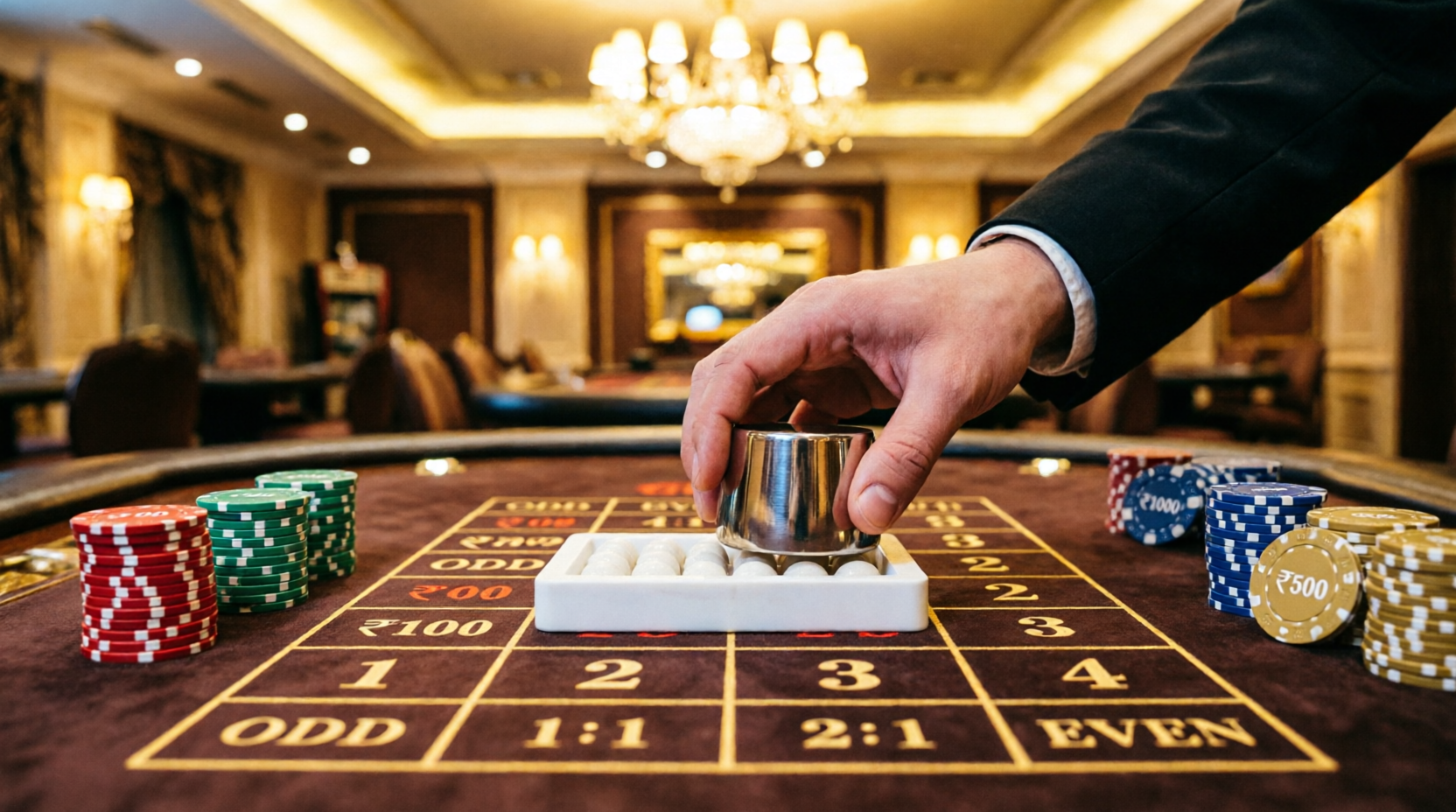
Fan Tan Live is one of the fastest-growing live dealer games in Indian online casinos, combining centuries of Chinese gambling tradition with modern Evolution Gaming technology. This ancient bead game has captured the attention of Indian players seeking simple, fast-paced entertainment with transparent odds and minimal complexity. Unlike many casino games that require extensive strategy knowledge, Fan Tan Live appeals to both beginners and experienced gamblers because the core mechanic is straightforward: predict which remainder (1, 2, 3, or 4) will result when the dealer counts beads into groups of four.
If you’re new to Fan Tan Live or looking to refine your approach in Indian-facing casinos, this comprehensive guide covers everything from rules and bet types to practical bankroll management and responsible gambling strategies tailored for Indian players using rupee stakes. We’ll explain the house edge for each bet, show you how to choose bets that match your risk tolerance, and help you avoid common mistakes that lead to unnecessary losses. By the end, you’ll understand not just how to play, but how to play sustainably.
What Is Fan Tan Live In Indian Casinos?
Fan Tan Live is Evolution Gaming’s live dealer version of the traditional Chinese bead game, now available at dozens of Indian online casinos. The game centres on a simple premise: a dealer covers a random pile of beads (or buttons) with a metal cup, then slowly reveals them and separates them into groups of four. The remainder—the number of beads left after the final group of four—determines the outcome. Players bet on which remainder (1, 2, 3, or 4) will occur, or on broader patterns like odd/even or big/small.
The appeal to Indian players is clear. Each round lasts just 60–90 seconds, the odds are transparent and equally distributed, and there’s no physical skill involved. You’re not trying to outplay opponents or predict complex probability chains; you’re simply choosing which of four equally likely outcomes you believe will happen. The low cognitive barrier and rapid round frequency make it ideal for players who enjoy continuous, low-pressure entertainment.
Origins And Evolution Of The Game
Fan Tan originated in China centuries ago and remained a staple in Macau gaming halls for generations. Traditionally, a dealer would cover a pile of buttons with a cup, then remove them in groups of four using a stick. The remainder determined the winner. Over time, the game evolved to include various multi-number bets and commission structures. Modern Macau casinos, where Fan Tan is still popular, typically charge a 5% commission on certain winning bets, which affects the effective payout.
Evolution Gaming brought this classic game to the live online environment, modernising the interface and betting options while preserving the fundamental randomness and appeal. The live dealer sits at a custom-designed table with a bead pile, a metal cup (called a tan koi bowl), and a computerised betting interface visible to players. The result is a game that feels authentic to traditional Fan Tan while being fully integrated into digital casino platforms, including those serving Indian players.
Live Dealer Setup For Indian Players
When you play Fan Tan Live at an Indian casino, you connect to a professional studio via a high-definition video stream. The dealer is visible at all times, and you interact through a betting interface on your screen. The typical round flow is as follows: the betting window opens (usually 15–30 seconds), during which you place your bets on the predicted remainder or pattern. Once the window closes, the dealer covers a pile of beads with the cup, then begins revealing and counting them into groups of four. The animation is smooth and clear, making it easy to follow the count. Once the remainder is identified, the system automatically settles all bets, and a new round begins.
The entire experience is designed for rapid, continuous play. Indian casinos often localise the interface with Hindi/regional language support, rupee stakes starting from ₹10–₹100 per bet, and payment methods common in India such as UPI, NetBanking, and e-wallets. The live chat feature allows you to interact with dealers and other players, adding a social dimension that appeals to many Indian gambling enthusiasts.
Core Fan Tan Live Rules And Round Flow
Understanding the exact sequence of play is essential for making informed bets. Here’s how each round unfolds in Fan Tan Live:
- Betting window opens: A new round begins, and the betting interface displays all available bet types and odds. This window typically remains open for 15–30 seconds.
- Players place bets: You select your desired bet type (e.g., Fan, Kwok, even/odd) and stake amount in rupees. You can place multiple bets in a single round.
- Betting window closes: Once the timer expires, no more bets are accepted. The dealer announces “no more bets” and covers the bead pile with the metal cup.
- Beads are revealed: The dealer slowly lifts the cup, and the beads or buttons become visible to the camera. The camera angle is positioned to ensure clear visibility.
- Counting into groups of four: The dealer (or an automated system) counts the beads into groups of four. This is typically done with a stick, removing groups sequentially.
- Remainder identified: Once all complete groups of four are removed, the remaining beads (0, 1, 2, or 3) are counted. A remainder of 0 is treated as 4 in Fan Tan terminology, so outcomes are always 1, 2, 3, or 4.
- Bets are settled: The system automatically determines which bets win, applies payouts, and displays results. All winning bets are credited immediately to your account.
- New round begins: The interface resets, and the next betting window opens.
Each outcome (1, 2, 3, or 4) has an equal probability of 25%, since the bead count is determined by a random quantity of beads covered at the start. This equal likelihood is why more exotic bets carry higher payouts—they cover fewer outcomes but maintain the same win probability as simpler bets.
Betting Phases And Result Announcement
The betting phase is carefully timed to give all players a fair chance to place wagers. Once you’ve submitted your bets, you can watch the countdown timer and prepare for the result. Some casinos allow you to adjust or add bets during the window; others lock in your original wager immediately.
The result announcement is clear and emphatic. The system displays the winning remainder prominently on screen, often with visual animations showing the bead count. Live chat may light up with congratulations or groans from other players, adding to the atmosphere. The settlement is instant—if you’ve won, your account is credited within seconds. If you’ve lost, those funds are removed from your balance, and you can place new bets in the next round.
Fan Tan Live Bet Types And Payouts
Fan Tan offers more bet variety than many casual players realise. Here’s a detailed comparison of the main bet types available in Evolution Live casinos:
| Bet Type | Numbers Covered | Typical Payout | House Edge | Risk Level |
|---|---|---|---|---|
| Fan (single) | 1 number | 3:1 | ~3.75% | High |
| Nim (two-number push) | 2 numbers | 1:1 or push | ~2.5% | Medium |
| Tan (two-number push) | 2 numbers | 1:1 or push | ~2.5% | Medium |
| Kwok (two-number both win) | 2 numbers | 1:1 | ~2.5% | Medium |
| Nga Tan (three-number push) | 3 numbers | 1:2 or push | ~1.25% | Low |
| Sheh-Sam-Hong (three-number all win) | 3 numbers | 1:2 | ~1.25% | Low |
| Even/Odd | 2 numbers (odd=1,3 or even=2,4) | 1:1 | ~2.7% | Low |
| Big/Small | 2 numbers (big=3,4 or small=1,2) | 1:1 | ~2.7% | Low |
The payout ratios shown are approximate and based on traditional Macau structures; individual casinos may apply slightly different commission rates or promotional adjustments. House edge is expressed as a percentage of your stake that, over time, you should expect to lose. For example, a 3.75% house edge on a ₹1,000 Fan bet means the casino’s long-term mathematical advantage is ₹37.50 per ₹1,000 wagered.
Even/Odd And Big/Small Bets
Even/odd bets are among the most straightforward in Fan Tan Live. You’re simply predicting whether the remainder will be odd (1 or 3) or even (2 or 4). These bets typically pay 1:1, meaning a ₹100 winning bet returns ₹200 (your original stake plus ₹100 profit). The house edge is around 2.7%, which is slightly lower than single-number Fan bets, making them attractive for players seeking smoother variance and longer session sustainability.
Big/small bets follow a similar logic. Big covers 3 and 4, while small covers 1 and 2. Again, these pay 1:1 and have a house edge near 2.7%. The advantage of these bets is psychological as well as mathematical: they feel familiar (similar to roulette red/black), the payouts are predictable, and the shorter odds allow you to play longer on a fixed bankroll. Many Indian players prefer these bets as a foundation for their Fan Tan strategy, especially during their first sessions.
Advanced Pattern Bets: Kwok, Nga Tan And Sheh-Sam-Hong
For players seeking lower house edges, multi-number bets offer compelling value. Kwok bets cover two non-adjacent numbers (e.g., 1 and 3, or 2 and 4) and pay 1:1 if either comes in. The house edge remains around 2.5%, marginally better than Nim/Tan, and the bet feels more forgiving than a single-number Fan.
Nga Tan covers three numbers but includes a push mechanism: if one specific number hits, your bet is returned without profit or loss. For example, an Nga Tan on 1-2-3 might win at 1:2 if 2 or 3 hits, but push (return stake) if 1 hits. This structure lowers the effective house edge to approximately 1.25%, making it mathematically one of the best bets in Fan Tan. However, the push outcome reduces volatility in a way that can feel anticlimactic to some players.
Sheh-Sam-Hong is the most conservative multi-number bet, covering three numbers with even odds (typically 1:2 payout). If any of the three numbers hits, you win at those odds with no push. The house edge is around 1.25%. For players willing to sacrifice higher payout potential for consistency and lower variance, Sheh-Sam-Hong is an excellent long-term choice.
Understanding Probabilities, House Edge And Variance
The mathematical foundation of Fan Tan is simple but crucial to understand. Since the dealer covers a random quantity of beads at the start of each round, and then counts them in groups of four, the remainder is equally likely to be 1, 2, 3, or 4. This means each outcome has exactly a 25% probability. Over thousands of rounds, you’d expect to see each remainder roughly one quarter of the time.
This equal distribution is why the house edge varies by bet type. A Fan bet (single number) covers only 25% of outcomes, so the casino must pay 3:1 to attract players; however, after accounting for the casino’s 5% commission (or equivalent edge built into the payout), the effective house edge is around 3.75%. Two-number bets cover 50% of outcomes and pay roughly 1:1, yielding a house edge around 2.5–2.7%. Three-number bets cover 75% of outcomes, pay less (around 1:2), and thus have the lowest house edge, near 1.25%.
These percentages might seem small, but they compound over time. If you play 1,000 rounds at ₹100 per bet on a 2.7% house-edge bet, you should mathematically expect a loss of ₹2,700. This doesn’t mean you’ll lose exactly that amount; variance means you might lose ₹5,000, win ₹1,000, or hit something in between. But across large sample sizes, the house edge is relentless.
Why There Is No Guaranteed Winning Strategy
Many players search for a “winning system” for Fan Tan, often inspired by YouTube videos or casino forums. However, several fundamental facts render all such systems ineffective:
- Each round is independent: The outcome of round 1 has zero influence on round 2, round 3, or any future round. A streak of remainders like 1-1-1-1-2-2 tells you nothing about what comes next; the next round is still 25% likely to be any of the four numbers.
- Hot numbers are a fallacy: Just because the number 3 has hit five times in the last 20 rounds doesn’t mean it’s “due” for a cooldown. Randomness produces streaks naturally, and chasing them by increasing your stakes on perceived “cold” numbers typically increases losses.
- Doubling down after losses doesn’t reset odds: If you’ve lost three consecutive ₹100 bets and decide to bet ₹300 on the next round to “catch up,” your odds of winning remain 25% (or 50%, or 75%, depending on your bet type). You’ve only increased the amount at risk, amplifying volatility without improving your mathematical position.
These misconceptions arise because humans are pattern-seeking creatures, and short-term randomness often looks like trends. However, probability theory guarantees that no betting pattern changes the underlying house edge or the equal distribution of outcomes.
Bankroll Management Strategies For Fan Tan Live
The difference between sustainable, enjoyable Fan Tan play and reckless gambling comes down to bankroll management. Your bankroll is the total amount of money you’ve set aside specifically for Fan Tan and other casino games—money you can afford to lose without affecting your essential expenses or financial obligations.
A practical approach for Indian players is to define a session as a fixed number of rounds (e.g., 50 rounds) or a fixed time period (e.g., 45 minutes), with a pre-set maximum loss limit. For example, if your total Fan Tan bankroll is ₹5,000 and you decide to risk no more than 20% per session, your session loss limit is ₹1,000. Once you’ve lost ₹1,000, you stop playing for that session, regardless of whether you feel you’re about to win. Conversely, if you’re ahead by ₹500 after 30 rounds, you might set a stop-win target to lock in that profit.
Similarly, your unit bet size should be a fixed percentage of your total bankroll—typically 1–2% per bet for conservative play, or up to 5% for more aggressive players. If your bankroll is ₹5,000, a 2% unit is ₹100. You’d place every bet at ₹100 (or multiples thereof, if combining bets) until you reach your session loss limit or stop-win target. This approach prevents the temptation to chase losses by raising stakes after a losing streak.
Session Planning And Stop-Loss Rules
Define your session before you start playing. Decide how many rounds you’ll play (e.g., 50) and what constitutes a win or loss threshold. For ₹5,000 bankroll, you might set a stop-loss of ₹500 (10% of bankroll) and a stop-win of ₹250 (5% profit). Once either limit is hit, you close the session. This discipline is hard to maintain when you’re caught in the moment, but it’s the primary safeguard against the variance that can deplete a bankroll in minutes.
Another effective strategy is time-based session limits. Set a timer for 45 minutes. During that time, you play continuously, but once the timer expires, you stop immediately. This removes the temptation to “just one more round” after a bad streak. Indian casinos’ 24/7 availability means endless rounds are always waiting; discipline and scheduled breaks are essential.
Stake Sizing For Different Player Profiles
Conservative recreational players might budget ₹2,000 for Fan Tan per month, play 4 sessions of ₹500 each, use 2% units (₹10 per bet), and set a 10% session loss limit (₹50). Over four sessions, they’d expect to lose roughly ₹27 (2.7% × ₹1,000 wagered across all sessions), a small entertainment cost.
A more aggressive player with a ₹10,000 monthly budget might allocate ₹5,000 to Fan Tan, play 5 sessions of ₹1,000 each, use 5% units (₹50 per bet), and set a 15% session loss limit (₹150). Their expected loss would be around ₹135, but their variance is higher—they might win or lose ₹500+ in a single session.
High-roller players with ₹50,000+ bankrolls might maintain similar loss caps (₹500–₹1,000 per session) despite higher unit sizes, thereby extending their play duration and flattening the impact of variance on their overall experience.
Optimal Bet Selection And Strategy Frameworks
Rather than searching for a “system,” successful Fan Tan players choose a consistent bet selection strategy and stick to it within their bankroll limits. Here’s a framework comparing different approaches:
| Strategy Style | Primary Bet Type | Volatility | House Edge Focus | Suitable For |
|---|---|---|---|---|
| Even-Money | Even/odd or big/small | Low | Moderate (2.7%) | Conservative players seeking long sessions |
| Two-Number Hybrid | Kwok, Nim, or mixed two-number bets | Low-Medium | Lower (2.5%) | Balanced players wanting better odds than even-money |
| Multi-Number Conservative | Nga Tan or Sheh-Sam-Hong | Very Low | Lowest (1.25%) | Disciplined players prioritising edge reduction |
| Single-Number Speculative | Fan bets only or primarily | Very High | Highest (3.75%) | High-risk tolerance players or pure entertainment |
| Mixed Approach | Combination of two-number and even-money | Medium | Moderate (2.5%–2.7%) | Flexible players adjusting bet type by session feel |
The key insight is that all legitimate strategies share a common foundation: fixed unit sizes, session limits, and acceptance of the house edge. The specific bet types you choose matter far less than your discipline in adhering to bankroll rules.
Focusing On Two-Number Bets For Consistency
Many experienced Fan Tan players gravitate toward two-number bets as a sweet spot. Compared to single-number Fan bets, they offer better odds (lower house edge) and higher win frequency (50% vs 25%). Compared to even-money bets, they provide marginally better edge and still feel like “real” bets rather than simple flips. Here are the main trade-offs:
- Advantage: Higher frequency of wins reduces losing streaks, which is psychologically valuable. The 2.5% house edge beats Fan bets’ 3.75%.
- Advantage: Two-number bets maintain moderate payout (1:1), so ₹100 stakes yield ₹100 profit on wins—straightforward and satisfying.
- Disadvantage: They’re more complex to track than even/odd or big/small, which may confuse newer players.
- Disadvantage: If you prefer the simplicity of “odd or even,” two-number bets feel unnecessarily complicated.
For Indian players new to Fan Tan, a sensible entry point is even/odd or big/small for the first 2–3 sessions, then experimenting with Kwok or mixed two-number combinations once you’re comfortable with the game flow.
Live Fan Tan Strategies Tailored For Indian Casinos
Indian-facing casinos running Evolution Fan Tan Live typically offer the core bet types (Fan, Nim/Tan, Kwok, even/odd, big/small) with rupee stakes from ₹10–₹100 minimums and ₹5,000–₹50,000 maximums depending on the operator and table. Some casinos promote advanced bets like Nga Tan and Sheh-Sam-Hong, while others keep the interface streamlined to basic options.
A practical approach for Indian players is to start with lower-volatility bets (even/odd or big/small) at conservative stakes, then—once you’ve played 100+ rounds and understand your own risk tolerance—experiment with two-number bets or carefully chosen multi-number bets. This progression lets you feel the rhythm of the game, experience realistic variance, and make informed decisions about stake sizing before you commit larger amounts.
Adapting To Indian Casino Bonus And Promotion Structures
Many Indian casinos offer welcome bonuses (e.g., 100% match up to ₹5,000) or free spins/free plays for live dealer games. However, bonus terms often include wagering requirements: you might need to bet the bonus amount 15–25 times before withdrawing. The key is understanding how that requirement applies to Fan Tan specifically.
Some casinos weight live dealer games at 50% toward wagering contributions, meaning a ₹1,000 bet on Fan Tan counts as ₹500 toward your requirement. This effective doubling of your wagering burden means bonus play on Fan Tan is less lucrative than on weighted slots. If you claim a ₹5,000 bonus with a 20× requirement (₹100,000 in total bets), but Fan Tan counts at 50% weighting, you effectively need to place ₹200,000 in bets—a massive commitment even for regular players.
Before accepting a bonus, calculate the real cost in terms of wagering and time. In many cases, skipping the bonus and playing with your own cash at disciplined stakes is smarter than chasing a bonus that locks you into extended play at sub-optimal odds.
RTP, RNG And Fairness In Indian-Facing Live Casinos
Return to Player (RTP) and live dealer randomness work differently in Evolution Fan Tan Live compared to slot games. Slots use a software-based Random Number Generator (RNG) to determine outcomes. Fan Tan uses a physical process (the dealer covering and counting beads) combined with an RNG or controlled system to determine the initial bead quantity. This hybrid model ensures fairness while allowing live video streaming.
Indian casinos licensed by reputable authorities (like eCOGRA or Gaming Commission of Malta) are obligated to publish their RTP and undergo regular fairness audits. A fair Fan Tan Live game should have an RTP that aligns with its published house edge: for example, an even/odd bet with a 2.7% house edge should have an RTP of 97.3%.
To verify fairness, check your casino’s license information, search for published RTP/house edge documentation, and look for third-party audit badges. Avoid casinos with no licensing transparency or that refuse to disclose game parameters. Licenced, regulated casinos in India’s legal grey area (like those regulated by European authorities but serving Indian players) are far safer than unlicensed operators.
Common Mistakes And Responsible Gambling Guidelines
Even experienced gamblers fall into traps when playing Fan Tan. Here are the most frequent errors and how to avoid them:
- Chasing hot numbers: You see that 3 has come up six times in the last 15 rounds and bet heavily on 3 to hit again. This ignores independence; the next round is still 25% likely to be any outcome. Instead, maintain fixed stakes regardless of recent results.
- Increasing stakes after losses: After losing three ₹100 bets in a row, you bet ₹300 to “catch up.” This martingale-style thinking accelerates losses. Your odds remain unchanged, but your risk is now tripled. Stick to your unit size.
- Misunderstanding commission and edge: You win a Fan bet at 3:1 payout but don’t realise the casino’s 5% commission reduces your actual profit. You think you’re getting great value when the house edge is actually above 3.5%. Always confirm exact payouts with your casino.
- Playing with emotion after losses: You’ve lost ₹500 and feel frustrated or determined to “get it back.” This emotional state clouds judgment and often leads to reckless stakes. If you’ve hit your session loss limit, stop. Walk away, cool off, and return with a clear head.
- Ignoring time and session limits: “Just one more round” turns into 2 hours of continuous play. Fatigue and decision fatigue erode discipline. Set alarms for session end times and honour them.
- Neglecting responsible gambling tools: Most Indian casinos offer deposit limits, loss limits, and self-exclusion options. If you find yourself struggling to stick to your bankroll plan, use these tools immediately. They exist to protect you.
- Redepositing impulsively: You’ve lost your session bankroll and immediately deposit more money to continue playing. This is a major warning sign of problem gambling. Only deposit during scheduled, planned sessions.
Building A Sustainable Long-Term Approach
Sustainability in Fan Tan comes from accepting two truths: first, the house edge means you’ll lose money over time if you play long enough; second, short-term variance means you can enjoy winning sessions and entertainment value despite the long-term edge.
To build a sustainable approach, treat Fan Tan as entertainment with a cost (your expected losses), not as an income source or wealth-building tool. Allocate a fixed monthly entertainment budget (e.g., ₹2,000), divide it into sessions, and never exceed that total regardless of losses or wins. Within each session, use fixed bet sizes and clear stop-loss/stop-win limits. Choose bet types with lower house edges when possible (Nga Tan, Sheh-Sam-Hong, or even/odd over Fan). Finally, use responsible gambling tools offered by your casino, take regular breaks, and seek support if you find yourself unable to stick to your limits.
The combination of discipline, realistic expectations, and lower-edge bet selection doesn’t eliminate the house advantage, but it ensures you’re giving yourself the best possible chance to enjoy Fan Tan without financial harm. Play responsibly, stay within your means, and remember that the real entertainment is in the game itself, not in the fantasy of beating the odds.